

Ressurecio
Performance, Sculpture, Video, 2017
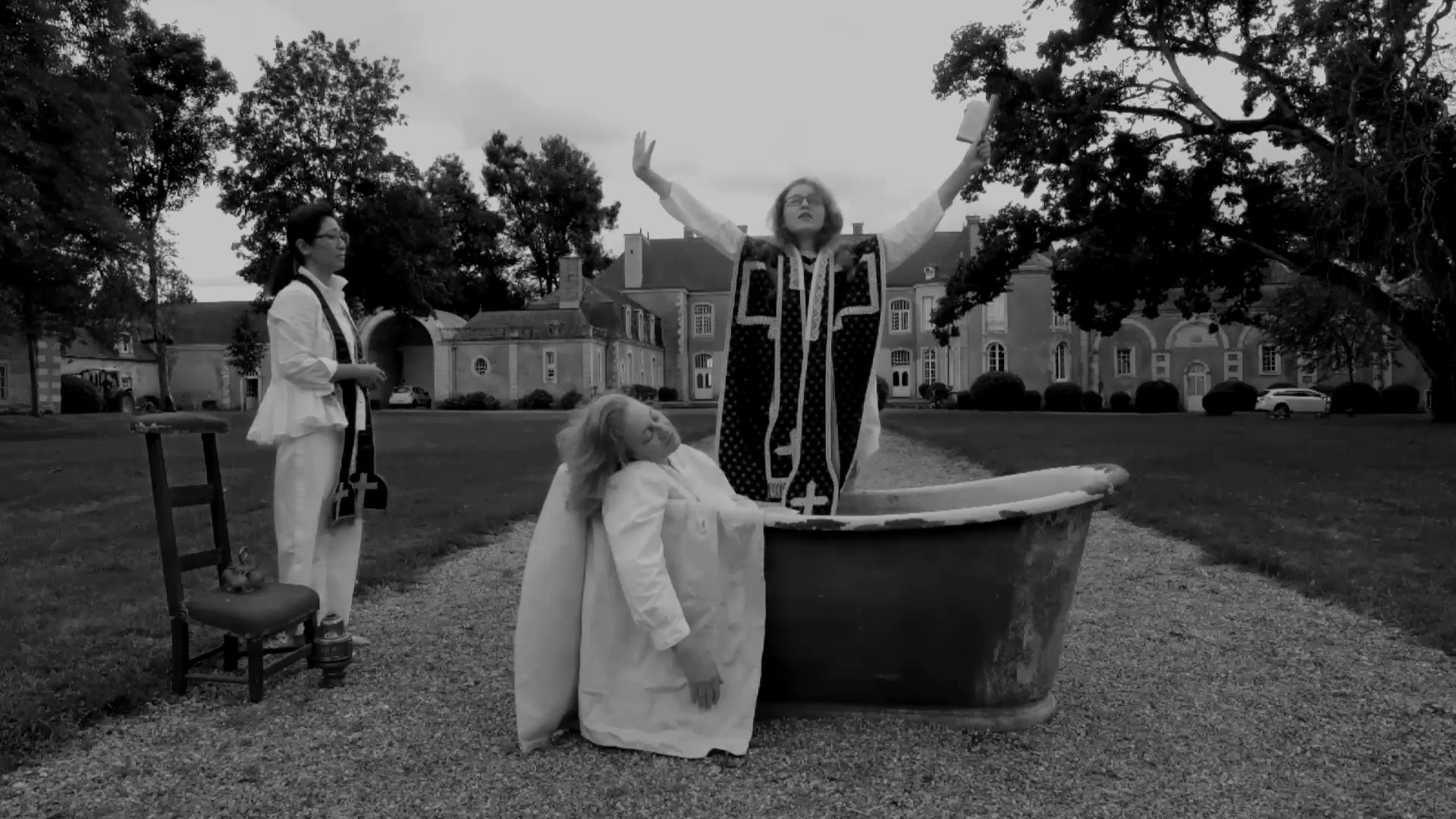
This project was conceived at the visual art residency as the first Philippine participant of the Fondation La Roche–Jacquelin in France. The residence took place in an 18th century château within a 60-hectare young forest in Le Departement de Maine et Loire, West of Paris, France. I was inspired to connect to the place and its history. Immediately my gaze was drawn to the chapel, commonly built as part of the household in many of these French châteaux. As I rummaged through some of the château and chapel’s old furniture, I chose to work with and re-use château detritus as materials: an old bathtub, old metal grills and glass lamp shades, desanctified ecclesiastical paraphernalia (bells, altar candles, bibles, missalettes), antique french provincial prie-dieu, and Catholic priests’ religious vestments, in an attempt to bridge religion and history with the elements present to me then.
resurrectiō is a multi-media project consisting of a performance, sculptures, and a documentary video. Performed at the château’s front lawn, a blessing ritual, “pausok” in Filipino, consecrated the materials while re-enacting one of the most famous images of the French Revolution, Jacques-Louis David’s 1793 painting, The Death of Marat. One of the materials, a bathtub contains a figure that re-creates the scene of the murder of French revolutionary leader, Jean-Paul Marat. This attempts to connect with the marked grave on the castle grounds. The grave remembers the massacre of a general and his counter- revolutionary forces (approximately 300 people).

Before the procession, a few participants were asked to kneel on a cement-laden prie-dieu and reflect on a time in their lives when they were going through pain (physical or otherwise), resembling ‘confessions’. One word they uttered was then marked with nails on the arm-rest. In a Catholic confession, a person reveals to a priest one’s private thoughts or past incidents, acknowledging legal or moral wrong doings (technically called sins) to ask for forgiveness. Psychologically, this relieves the confessor of anxieties associated with keeping secrets. The intention was to relieve the community of the pain that blocked the energies that must flow towards the blessing.

After the performance, I re-created the bathtub to resemble a Kinari, a half-bird and half- human mythical creature symbolising beauty, grace and accomplishment. From death to life through the cleansing ritual, Nana Kinari transgresses cultural and temporal meanings and creates a new narrative, one of a protector of the land. Nana Kinari, painted with gold and tattooed with 16th century sketches of Philippine inhabitants from the Boxer Codex, sits across the field from the existing statue, whose head was shot at with a gun by the château’s previous owner.

